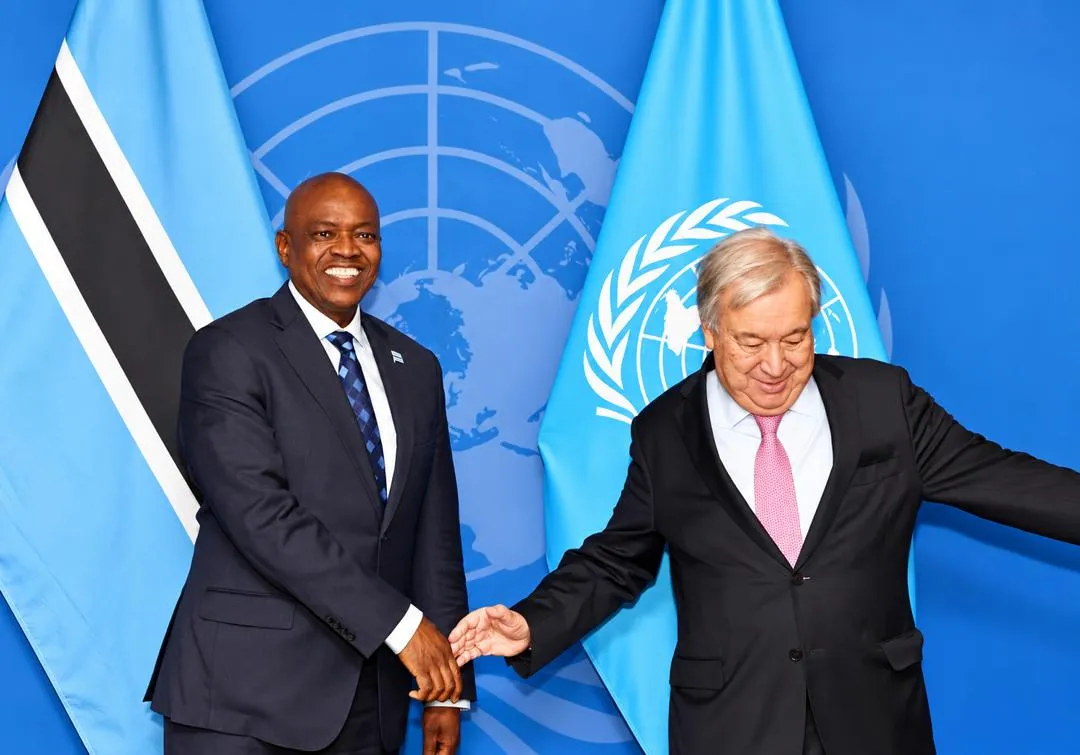
Masisi appointed co-chair of UN panel on transit for landlocked countries
Former President Mokgweetsi Masisi has been appointed Co-Chair of a new United Nations High-Level Panel on Freedom of Transit for Landlocked Developing Countries. United Nations Secretary-General António Guterres named Masisi alongside Slovenian President Nataša Pirc Musar and Luxembourg’s Deputy Prime Minister Xavier Bettel. The panel will review existing transit agreements and recommend improvements under the Awaza Programme of Action for 2024–2034.
Former President Mokgweetsi Masisi will serve as one of three co-chairs on the United Nations High-Level Panel focused on freedom of transit. The United Nations Secretary-General António Guterres named Masisi alongside Slovenian President Nataša Pirc Musar and Luxembourg’s Deputy Prime Minister Xavier Bettel. The panel addresses challenges faced by landlocked developing countries that rely on neighbouring states for access to ports and markets. It also examines the implementation of international laws on transit, identifying gaps and constraints, and preparing recommendations. These recommendations will be submitted to Member States at the 82nd session of the UN General Assembly.
Botswana, as a landlocked nation in Southern Africa, stands to benefit from improved transit frameworks. The appointment places a Botswana leader at the centre of efforts to strengthen regional and international cooperation on trade routes. The initiative forms part of the Awaza Programme of Action for Landlocked Developing Countries covering 2024 to 2034. It builds on earlier UN efforts to reduce the economic disadvantages caused by lack of direct sea access.
The TselaJournal staff writer covers breaking news across the country, focusing on events as they unfold and providing immediate context to significant developments. Their work encompasses a broad spectrum of daily reporting, from government announcements and policy changes to community events and major incidents. This journalist frequently produces timely news reports that explain the immediate impact of current affairs, as well as developing stories that trace ongoing situations. A story often begins with an alert from an official source or an observation from the ground, prompting swift investigation. They prioritise direct engagement with primary sources, conducting interviews with individuals directly involved or affected, and cross-referencing information with official statements and verified documents. Accuracy and speed are paramount in their approach, ensuring that readers receive reliable information as quickly as possible. Every detail is meticulously checked for veracity, and multiple sources are consulted to confirm facts before publication. Readers who follow this staff writer gain a clear, concise, and up-to-the-minute understanding of the day's most important events. Their reporting provides essential information that helps audiences stay informed about the rapidly changing landscape, offering not just what happened, but also why it matters in the immediate context. Their dispatches are a reliable first point of contact for understanding pressing national issues.